
 Jan
Jan 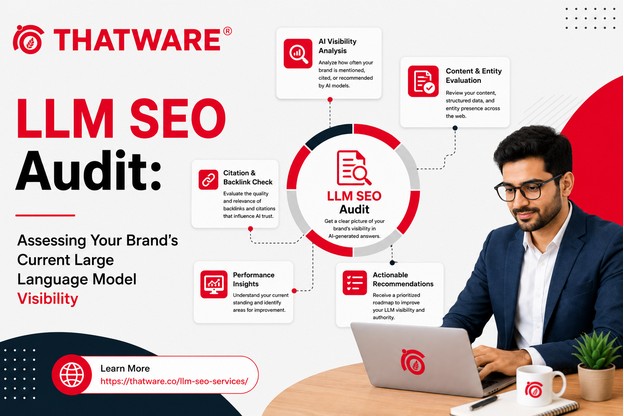
Before you can improve your AI visibility, you need to know where you actually stand. And that’s harder than it sounds, because unlike traditional SEO where you can pull a rankings report and immediately see your position for a thousand keywords, LLM visibility requires a more deliberate and creative approach to measurement.
An LLM SEO audit is the starting point. Done properly, it gives you a clear baseline — what AI models currently know (and don’t know) about your brand, how you’re described when you’re mentioned, where you’re showing up versus being missed, and what specific gaps need to be addressed. Done poorly, it gives you a comforting-looking report that doesn’t actually illuminate anything useful.
Here’s what a credible audit actually looks like.
Phase One: Query Universe Construction
The first step is figuring out what questions to ask. This isn’t a step to rush. The quality of your audit depends almost entirely on the quality and relevance of your query set.
You want to cover multiple types of queries: discovery queries (“what are the best tools for X?”), use-case queries (“what should I use for Y if I need to do Z?”), comparison queries (“how does Brand A compare to Brand B?”), credibility queries (“is [your company] reliable?”), and expertise queries (“who are the leading experts in [your category]?”).
For a thorough audit, you’ll typically want 50 to 150 queries, depending on the breadth of your market position. Each query should be something a real person in your target audience might plausibly ask an AI assistant. Not keyword strings — natural language questions. Because that’s what people are actually typing.
Phase Two: Systematic AI Response Testing
With your query universe built, you test each query across multiple AI platforms. At minimum: ChatGPT, Perplexity, Google AI Overviews, and if relevant, Claude or Bing Copilot. Results can vary significantly between platforms — a brand well-represented on one might be invisible on another.
For each query, document: whether your brand appeared in the response, what the AI said about your brand (verbatim, if possible), how your brand was categorized, which competitors appeared alongside or instead of you, and any inaccuracies or gaps in how your brand was described.
This documentation phase is tedious but non-negotiable. You can’t analyze patterns you haven’t captured. The raw response data is the foundation of everything else.
Phase Three: Brand Representation Analysis
Now you analyze what the AI models are actually saying about you — when they say anything at all.
Several dimensions matter here. Accuracy: Is what the AI says about your brand factually correct? Wrong product descriptions, outdated market positioning, misattributed features — these are damaging even when the citation happens. Completeness: Is the AI describing the full scope of what you do, or just one dimension? A company with five product lines that only gets cited for one has a representation gap. Category alignment: Is your brand appearing in the right category conversations? If you’re a B2B analytics company but you’re only being cited in consumer data contexts, something is off.
Sentiment and framing also matter. AI models sometimes frame brands in the context of comparisons, and the way that framing is constructed — “Brand X is a good option for smaller teams but may lack enterprise features” — reflects the information the model has absorbed about you. Understanding how you’re framed helps identify narrative gaps in your web presence.
For companies doing this as part of LLM SEO services reviews or initial strategy work, this phase often produces the most actionable insights. Brands are frequently surprised by how the AI actually represents them — sometimes positively, often with gaps, occasionally with outright errors that stem from inconsistent or outdated web presence.
Phase Four: Competitive Gap Analysis
Your AI visibility doesn’t exist in a vacuum. Understanding how you compare to your main competitors — which queries they own that you don’t, how they’re described versus how you are, what coverage they have that you’re missing — turns your audit into a competitive intelligence tool.
For each of your top three to five competitors, run the same query testing process. Map where they appear that you don’t. Analyze what their web presence looks like in the areas where they’re winning AI citations that you’re losing. This gap analysis often reveals the specific strategic investments — content topics, publication relationships, entity signals, technical fixes — that would have the most leverage for your visibility.
The goal isn’t to copy competitors; it’s to understand what gives them AI authority in specific query categories and build a differentiated strategy for claiming the territory that matters most to your business.
Phase Five: Technical Entity Audit
Beyond the AI response testing, a thorough LLM SEO audit also examines your technical entity infrastructure. This includes: the accuracy and completeness of your schema markup, the consistency of your brand description across major web properties (your site, LinkedIn, Crunchbase, industry directories, Wikipedia if applicable), the quality and specificity of your product and service page content, and the structure of your internal linking as it relates to entity relationships.
Technical entity problems often explain why a brand with good content coverage still underperforms in AI citations. If schema markup categorizes your product differently than your editorial content does, models receive conflicting signals. If your brand name is inconsistent across sources, entity disambiguation becomes a problem.
LLM SEO optimization audits that include this technical layer give a more complete picture than ones that focus only on content and coverage. The combination — response testing, representation analysis, competitive mapping, and technical entity review — is what a comprehensive baseline looks like.
What to Do With Your Audit Results
A good audit doesn’t just document problems — it prioritizes them. Some gaps are quick wins: a technical fix to an inconsistent schema, updating stale product descriptions, correcting an inaccurate representation on a key directory listing. Others are longer-term initiatives: building a presence in a publication category where you’re invisible, developing original research to create citable data, or launching a systematic entity-building program.
The audit output should be a prioritized action plan — ranked by expected impact and feasibility, mapped to timelines, and tied to the specific gaps it addresses. Not a list of recommendations, but a genuine strategic roadmap with the audit findings as its foundation.
Think of the LLM SEO audit as a GPS calibration. You can’t navigate well without knowing where you actually are. Start there, with rigor and honesty, and everything that follows will be better directed.
